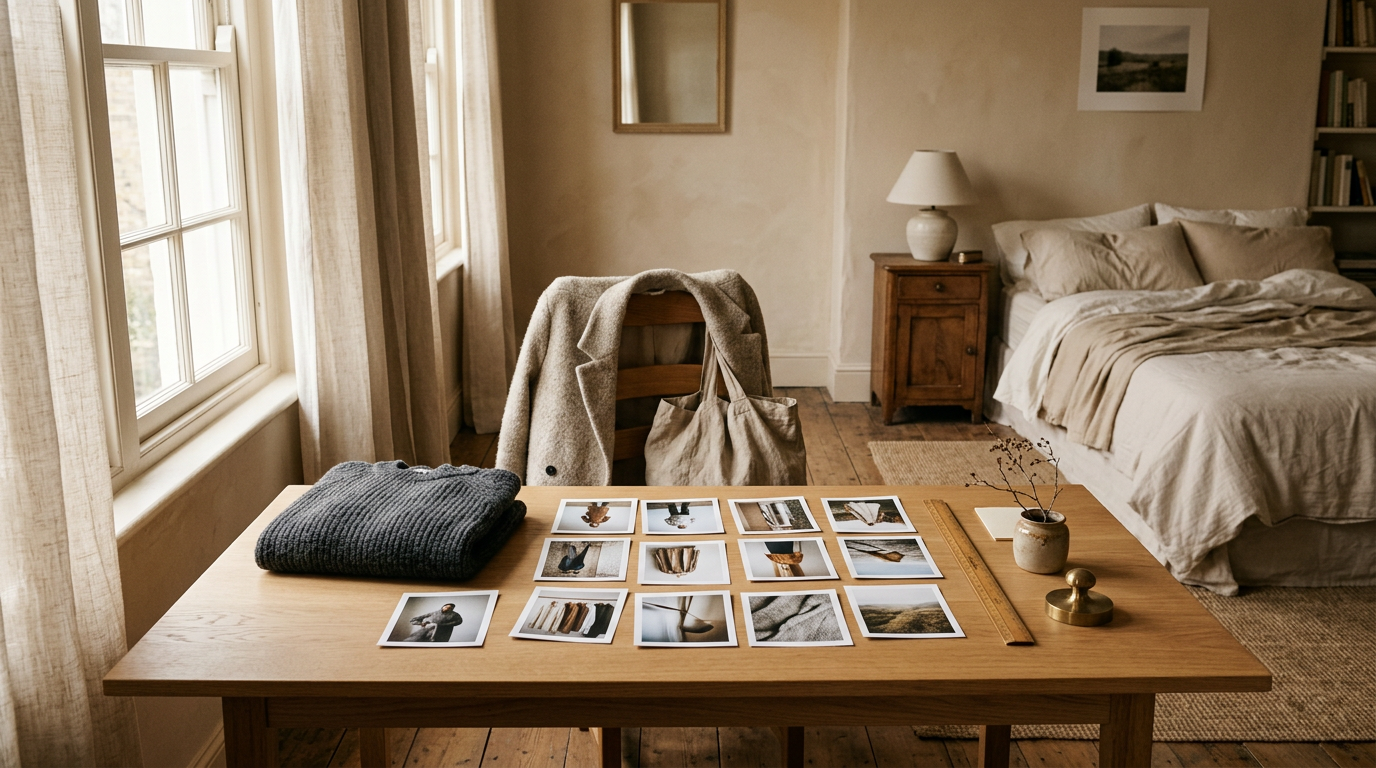
You save aggressively. You buy selectively. Somewhere between those two habits is a folder with hundreds of screenshots and a closet that still feels like it’s missing something.
The folder isn’t the problem. It’s data. Most of us just scroll it for vibes instead of reading it for information. Here’s how to read it.
Scroll it like someone else made it
Set aside twenty minutes. Open the folder and go through it fast, without zooming in on any single image. You’re not choosing outfits yet. You’re noticing what your thumb keeps stopping on.
Fast scrolling helps because your taste shows up in repetition, not in any one save. The one-off screenshot from a trip you took is a mood. The fourteenth image of a long coat over a slip skirt is a pattern.
Tally what repeats
Grab a notes app or an actual piece of paper. As you scroll, make a mark every time one of these shows up:
- Silhouette: Is the top boxy and the bottom narrow? Long and lean all the way down? Oversized on top, fitted below?
- Color: Name the actual shades. “Neutral” is too vague. Think oatmeal, chocolate, charcoal, ivory, a certain washed-out blue.
- Layering move: A collared shirt under knitwear. A slim tee under a slip dress. A belted coat over everything. A cropped jacket over something longer.
- Texture: Brushed wool, crisp poplin, fine-gauge knit, leather that’s gone soft.
- Proportion of the hem: Where does the outfit end? Ankle, mid-calf, hip, waist?
Don’t overthink the counting. When you’re done, three or four things will have a lot more marks than the rest. Those are your real inspo, and everything else is background noise.
Separate “I love this on her” from “I’d wear this”
This is the step that saves your budget. A lot of what we save is admiration, not intention. Admiration is valid, but it doesn’t belong on a shopping list.
Take your top repeating patterns and run each one through a few honest questions:
Would I wear this on a regular Tuesday? Not at the best event of the year. On a normal day, with your commute, your bag, and your actual plans.
Is it the outfit or the person? Sometimes the pull is the styling, the lighting, the setting, or the way she’s standing. If you take away the backdrop, do you still want the clothes?
Do I already reach for something like it? If a silhouette shows up in your folder and also in your closet, you’re not missing it. You’re just not wearing it the way the screenshot does.
Be ruthless here. Plenty of saves will turn out to be “love this on her,” and that’s fine. Leave them in the folder. They can stay inspo forever.
Do a quick fit check on what you own
Before you write anything down, pull up your closet next to your tally. Match what you already have to each pattern. If you keep saving a slim-over-oversized proportion, find the pieces you own that could do it.
Often the gap isn’t a whole outfit. It’s one layer: the right third piece, a better-fitting trouser, or a color that ties two things together. That’s a much smaller (and more interesting) shopping problem than “I need a new wardrobe.”
Write the gaps like a brief
Now the list. Keep it to three to five items, and make each one specific enough that you’d recognize it in a heartbeat and ignore everything else.
Compare these:
“A jacket.” That’s a browsing session with no end.
“A cropped, structured jacket in charcoal or black that sits at the waistband and works over a long skirt.” That’s a brief.
A good gap has a silhouette, a color, a job, and ideally a fabric. Add one more line to each item: what three things I own it works with. If you can’t name three, it’s probably a one-outfit piece, and it moves to the bottom.
Let the list slow you down
The point of the list is not to buy five things this week. It’s to make the next purchase a decision instead of a reaction. When something catches your eye, you check it against the brief. If it fits, great. If it doesn’t, you save it and move on without the cart guilt.
Saving is free, so keep doing it. Buying is where the edit happens.
Audit again when the folder changes
Your taste isn’t static, and your folder will show it. Run this audit at the start of each season, or any time you notice you’ve stopped opening the folder because it feels like noise. New patterns will show up. Old ones will fade. Both are useful.
When you’re ready to turn a gap into an outfit, Enter The Edit. Bring your list. The edit is everything.
Leave a Reply