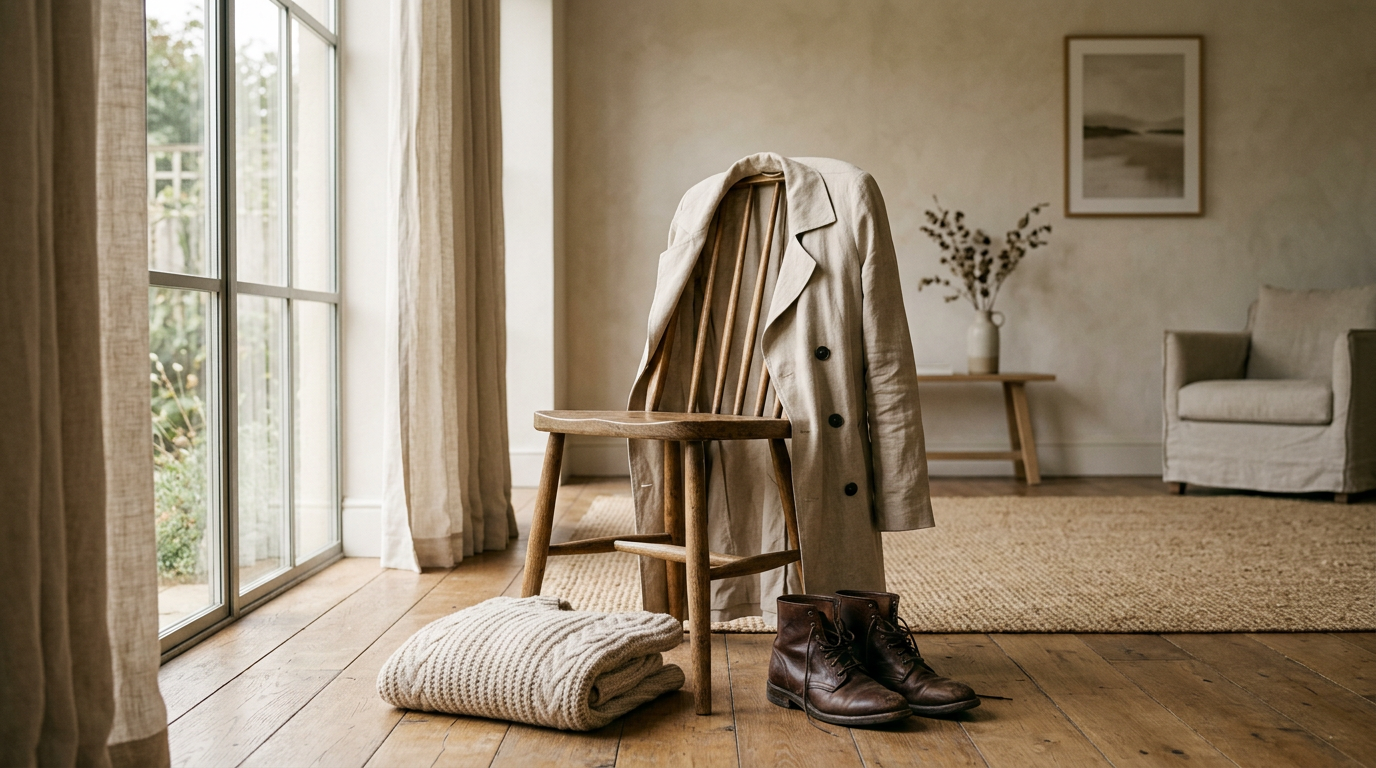
It’s 48 degrees at 8 a.m., sunny and warm by lunch, and windy again by the time you leave. The forecast has not made a decision, so you have to.
The good news is that between-seasons dressing isn’t about owning more. It’s about knowing what each layer is doing, and choosing fabrics by weight instead of by what the calendar says.
Start with weight, not season
Most of us sort clothes into “winter” and “summer” and then panic in the gap. A better sort is light, medium, and heavy.
Light is anything you can feel the air through: fine cotton, poplin, thin jersey, silky weaves. Medium has some body but still drapes, like a mid-weight merino, a brushed cotton, or a twill. Heavy is what you’d need a real cold snap to justify. For in-between weather, you’re building almost entirely from light and medium, with one piece of each doing a clear job.
Lightweight outerwear: what to look for
The in-between coat should block wind and shrug off a drizzle without making you sweat on the train. Look for a tightly woven cotton, a cotton-blend gabardine, or a technical-feeling fabric with a smooth hand. Tight weave is the point. It cuts the wind without adding bulk.
Pay attention to lining, too. A coat that’s unlined or only half-lined gives you range. Fully lined and padded is a winter coat in disguise.
On shape, go for something that sits over a knit without straining across the shoulders. Try it on with your thickest sweater and your thinnest tee. If it works with both, it earns its place.
The knit that works under and over
This is the hardest-working piece in the whole system. You want a fine- to mid-gauge knit in a fiber that breathes. Merino and cotton blends are both good here, and cashmere blends work if that’s your budget. It should be soft enough to wear against skin and structured enough to sit on top of a collared shirt.
A few things make a knit flexible:
- A neckline that plays both roles. A crew or a slim V works under a shirt and alone. A chunky turtleneck only works one way.
- A hem that doesn’t bunch. If it rides up under a coat, you’ll be tugging at it all day.
- A neutral that pairs with everything else you own. Oatmeal, charcoal, soft gray, and cream all disappear into other outfits, which is what you want.
Wear it under a blazer or open shirt for the cold start. Tie it around your shoulders or drape it over a bag when the sun comes out. Same knit, three different lewks.
The rule of one removable layer
Here’s the whole system in a sentence: every outfit gets exactly one layer you can take off and carry without it becoming a problem.
One, not three. Three removable layers means you’re hauling a second outfit around, and your tote starts to look like a gym bag. One means you’re prepared without looking like you hedged.
The removable layer should be the lightest thing that still does something. A jacket that folds over your arm, a cardigan that slides into a bag, an overshirt you can knot at the waist. Everything else in the outfit should look finished without it.
Quick test before you leave: take the layer off in the mirror. If the outfit still looks intentional, you’re set. If it suddenly looks like you forgot something, rethink the base.
Three formulas to adapt
These are templates, not prescriptions. Swap in whatever you own that matches the weight and the job.
- The Clean Base. Light tee or fine-knit tank, straight-leg trousers in a mid-weight fabric, a lightweight coat as your removable layer. Finish with a flat or low boot. This is the one for days that start cold and end mild, and the coat comes off without a single styling decision.
- The Knit Sandwich. Poplin shirt, then your versatile knit over it, then a shorter, lighter jacket on top. The knit is the middle layer, so it’s what you keep when the jacket goes. Pair with a midi skirt or relaxed denim. Roll the shirt cuffs over the knit sleeves for a bit of texture.
- The One-and-Done Dress. A mid-weight dress in a fabric with some drape, a fine knit worn open over it, and a scarf in a light weave as your removable piece. Add tights or bare legs depending on the day. The scarf handles the temperature swing around your neck, which is where you feel it most.
A few finishing notes
Shoes matter more than you’d think. In between seasons, you want something that handles a wet sidewalk and a warm afternoon. Leather boots with a clean sole or a structured loafer do both.
Keep your palette tight. When you’re layering, three colors that already like each other will always look more deliberate than five you’re hoping will work. Do a quick fit check in natural light before you head out, because layered outfits can look different by a window than they do under a bathroom bulb.
And remember the point of The Edit: fewer pieces, chosen well, worn hard. A light coat, a knit that moves between roles, and one layer you can lose. That’s most of the problem solved, and the forecast can do whatever it wants.