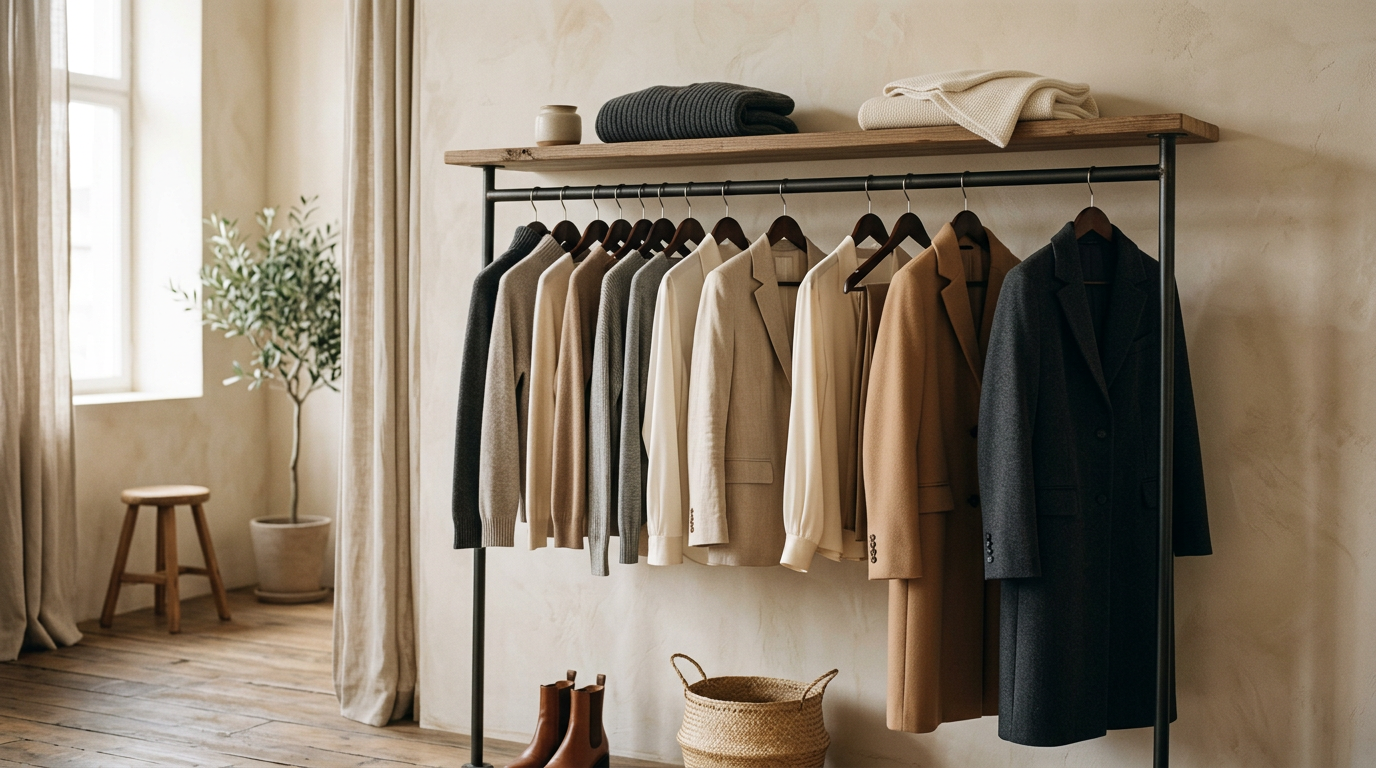
A capsule closet has a reputation problem. It sounds like a rule someone else made up: twelve pieces, one beige palette, zero fun. That’s not what we’re doing here.
Think of it as a fit check for your entire closet. The goal is to wear more of what you already love and buy less of what you don’t. Nobody is confiscating your favorite jeans.
One ground rule: twelve is a starting number, not a law. Shoes, bags, and jewelry sit outside it. We’re counting clothes only.
Step 1: Pick a color lane
Your lane is a small set of colors that all get along. It isn’t a uniform. It’s a home base.
To find yours, scroll back through your last handful of OOTDs or saved fit pics. Whatever keeps showing up is your lane, whether or not you’d call it a “style.” Most lanes come down to:
Two base neutrals that work together, like cream and charcoal, or camel and black. One in-between, like denim or olive. One accent that gives it personality, like dusty pink or rust.
Every piece in the capsule should work with at least two others. That’s the whole test.
And a lane doesn’t mean boring. Texture does the heavy lifting. A ribbed knit, a crisp poplin, and a heavy wool coat can share a palette and still read as three completely different moods.
Step 2: Decide where the weight goes
Not every category deserves equal space. Some pieces carry the capsule, and some are supporting cast. Here’s a split to start from:
- Tops (3): Your workhorses. Think a clean tee, a crisp button-up, and one that feels a little more interesting.
- Bottoms (3): Each one should work with every top. That’s what makes three bottoms and three tops into nine outfits.
- Outerwear (2): One for most days, one with more attitude. This is what people see first.
- Knitwear (2): One you’d live in, one you’d dress up.
- Wildcards (2): A dress, a statement piece, or anything that’s your lewk on its own.
Adjust it to your actual life. If you walk everywhere and layer year-round, give outerwear another slot. If you’re in an office or studio most days, lean harder on tops and bottoms.
Put your best thinking into outerwear and knitwear. They’re visible, they get rewarn constantly, and fabric makes or breaks them. This is where texture and fit matter most.
Step 3: Run the keep, maybe, let-go test
Now the part everyone dreads. Go category by category, not the whole closet at once, because that’s how a Saturday disappears. Pick up each piece and decide.
Keep. You’d wear it this week. It fits you now, not the version of you from two years ago or the one you’re planning to be. It sits comfortably in your lane. If you reach for it without thinking, it’s a keep.
Maybe. You like it, but something’s off. Maybe the fit is close but not right, the color fights your lane, or you love it and have nowhere to wear it. Put every maybe in one bag or bin and write a date on it, a month or two out. If you haven’t gone digging for something by then, you have your answer.
Let-go. It was bought for a version of you who didn’t show up. It needs a repair you’ve been avoiding for a year. It only works with one other thing. Or you feel guilty looking at it. Guilt isn’t a reason to keep anything.
Let-go doesn’t have to mean landfill. Resell it, swap it with a friend, donate it, or finally take it to a tailor if it’s one fix away from a keep.
Step 4: Count your keeps and name the gaps
Lay your keeps out against the split above. You’ll probably find you’re over in one category (hello, fourteen black tops) and missing something in another.
Write the gaps down. Don’t go buy them all at once. The point of an edit is that every piece earns its spot, and that takes a little patience.
You already screenshot outfits from half a dozen accounts before buying anything, so use that habit. Look at your saves and see what keeps repeating: a particular coat shape, a certain trouser length, a knit that looks heavy and drapey. Then fill the one gap that would unlock the most outfits first.
When you do buy, think about how it feels, not just how it photographs. Check the fabric, the weight, and how it moves. A piece you’ll wear forty times should feel good on the fortieth.
Step 5: Fit check the whole thing
Here’s how you know it works. Pick three outfits from your twelve and try them on. Take a photo of each, no filter and no overthinking.
If you can build all three without reaching outside the capsule, you’re done. If you got stuck, that’s useful information. Note what was missing, and that’s your next buy.
Expect to tweak it with the seasons. The capsule isn’t a permanent edit. Swap a knit for a lighter layer, move a coat to the back, bring your accent color forward. The framework stays, and the pieces rotate.
Done right, you’ll feel less like you gave things up and more like you can finally see what you have. Getting dressed gets faster, and the pieces you kept get worn more.
The edit is everything. Start with one category this weekend and see how it feels.